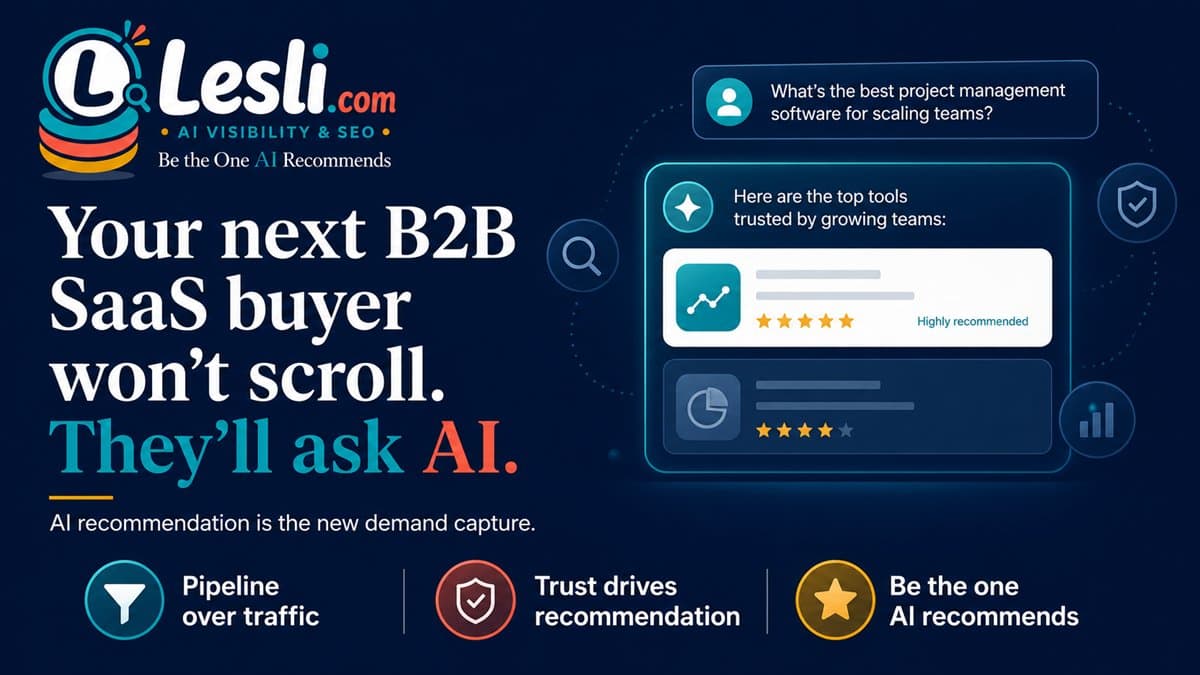
Your Next B2B SaaS Buyer Won't Scroll.
They'll Ask AI.
By Lesli Rose · June 9, 2026 · 4 min read
Most B2B SaaS companies still treat SEO like a traffic problem. Publish more, rank higher, watch the visits climb. It was never a traffic problem. And now it's barely about ranking at all.
Here's what changed. Your buyer used to search, scroll a page of blue links, and decide. Now a lot of them open ChatGPT or Perplexity, ask "what's the best tool for my problem," and act on the answer. They don't see ten options. They see the one or two the machine recommends. If that isn't you, you're not in the running. You never were.
So let me say plainly what makes SEO for a B2B SaaS company different from SEO for, say, an online store. Four things.
1. You're Not Chasing Traffic. You're Chasing the Few Right Buyers.
B2B SaaS keywords often have tiny search volume and enormous deal value. A term with forty searches a month can be worth more than one with forty thousand, because the right four people are worth a six-figure contract. Optimize for traffic and you win the wrong battles. The number that matters is pipeline.
2. The Purchase Is Slow and Crowded.
Nobody impulse-buys enterprise software. There's a champion, an end user, and someone who signs the check, and they all research separately. Intent is spread across the whole funnel, from "I think I have a problem" to "X versus Y." The work is matching content to each stage, and the money sits at the bottom: comparison pages, alternatives pages, integration and use-case pages. The content that catches people who are already evaluating.
3. It's Judged on Pipeline and CAC, Not Rankings.
SEO is demand capture. Its job is to lower customer acquisition cost over time and feed the pipeline. That's the language a CFO cares about. Rankings and traffic are leading indicators at best, and a strategist who reports them as results is selling, not strategizing.
4. Trust Does the Heavy Lifting.
These buyers are risk-averse. There's switching cost, security, data, and a job on the line if they pick wrong. So third-party proof matters more than your homepage: reviews, case studies, security pages, the things other people say about you.
And that last point is where the AI shift turns SEO from important to existential.
AI Models Are Consensus Engines
AI models don't recommend the brand with the slickest site. They recommend the one the wider web agrees is good. The technical foundation, the schema, the differentiated content, the reviews, all of it builds what Google calls E-E-A-T, and E-E-A-T is what earns machine trust. Machine trust is what earns the recommendation. And the recommendation is the new demand capture.
It doesn't even stop at the sale. The reviews and testimonials a happy customer leaves afterward become the strongest trust signals of all, and they feed the next recommendation. It compounds. Most companies treat the sale as the finish line. It's actually where the trust engine starts.
Want the tactical layer?
This article is the strategy. The execution side, G2 profiles, SoftwareApplication schema, comparison page structure, pricing transparency, lives in AI Visibility for SaaS.
The Tool Is Not the Advantage
Here's the part most teams get wrong about AI in all of this. They think the tool is the advantage. It isn't. Everyone has the same models. The output is only ever as good as the direction. AI can write content beautifully, but it cannot find what's genuinely different about your business, the real problem you solve and exactly who you solve it for. That takes a human who has done the work to understand the company. That judgment is the moat. AI runs the production. You keep the judgment.
So if you run SEO for a B2B SaaS company, stop measuring traffic and start asking a harder question. When a buyer asks AI what to buy, does it recommend you?
That's the whole game now. Everything else is a leading indicator.
Frequently Asked Questions
How is B2B SaaS SEO different from ecommerce SEO?
Four ways. You chase a few high-value buyers instead of traffic volume, the purchase cycle is long with multiple stakeholders researching separately, success is judged on pipeline and CAC instead of rankings, and third-party trust signals carry more weight because the buyers are risk-averse.
What metrics should B2B SaaS SEO be judged on?
Pipeline and customer acquisition cost. Rankings and traffic are leading indicators at best. A strategist who reports them as results is selling, not strategizing.
Does SEO still matter for B2B SaaS now that buyers ask AI?
More than ever, but the target moved. AI models recommend the brand the wider web agrees is good. E-E-A-T earns machine trust, machine trust earns the recommendation, and the recommendation is the new demand capture.
What content drives the most pipeline for B2B SaaS?
Bottom-of-funnel pages: comparison pages, alternatives pages, integration pages, and use-case pages. They catch the buyers who are already evaluating.
When a Buyer Asks AI, Does It Recommend You?
I'll test your product across ChatGPT, Perplexity, and Gemini. You will see exactly where you show up, where you do not, and what to fix.
Run Your Visibility Report